
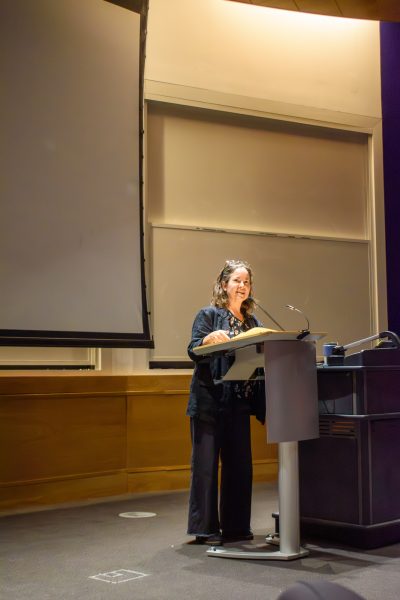
Poet and University of Texas at Austin professor Lisa Olstein visited St. Edward’s University on Feb. 19 for an evening reading in Carter Auditorium, sharing work from her most recent collections and offering a candid look into her creative process. The event ran from 6 to 7:30 p.m. and was part of the university’s Marcia Kinsey Visiting Writers Series, with refreshments provided and a book table where attendees could purchase her work.
Olstein is the Ellen Clayton Garwood Centennial Professor of Creative Writing at UT Austin and the author of six poetry collections and two books of nonfiction, all marked by what critic Frederick Aldama has called a space “where the lyric mode meets the essay’s searching intelligence.” The recipient of a Guggenheim Fellowship, a Pushcart Prize and a Writers League of Texas Book Award, among many others, she has built one of the most distinctive bodies of work in contemporary American poetry. Her newest collection, “Distinguished Office of Echoes,” (2025) was available at the book table alongside her earlier titles.
At the podium, Olstein opened with poems from “Dream Apartment” (2023) which she described as an exploration of “dream architecture,” the recurring forms and logic that dreams share across people and cultures.
Poems are like dreams, she said ‘ … we put in them what we don’t know we know,’ she explained that the collection pursues how poetic form, like dream form, surfaces what lies just below conscious thought.
The poems she read were short and vivid, “one thing just becomes the next, becomes the next,” she said, while others were longer and novelistic, stating “a bit of a romp sometimes.”
The evening’s visually compelling moments came with “Distinguished Office of Echoes,” a hybrid of collage and erasure built from three 19th-century reference texts: Hutchinson’s Physiology and Hygiene, Marine Study from 1865 and Ancient Greek Primer from 1905. Olstein had collected the books over 16 years, dipping into them periodically during moments of uncertainty or difficulty, before finally immersing herself fully during the pandemic while ill with COVID-19. Over nine months, she tore out pages, painted over them and layered them into sequences, with no copies, no backups and no way to undo her choices.
“If I made the wrong move, I had to find an alternative,” Olstein told the audience. “There was no going back. Which was, of course, totally agonizing and also really awesome.”
The Q&A drew out some of the night’s most memorable exchanges. When asked about poems where only punctuation remained — the words stripped away, the marks left bare — Olstein described, preserving a rhythm of thought while removing the thought itself. They become almost time signatures, or like scoring, but with the notes removed.”
She credited Anne Carson’s translations of Sappho as an influence, praising the way Carson preserves the physical gaps between fragments rather than smoothing them over.
“Words in proximity create meaning — they cannot not,” she said. “But now there is an extra emotional valence of pause, and this presence of the absence.”
I asked how she knew when a poem was done, her answer was practical: The ear doesn’t lie. I always read my work aloud, and when the ear is satisfied, that’s a good signal.”
And on why she chose poetry as a career at all, she was disarmingly honest. After spending time at Harvard Divinity School and in women’s health work, she had a realization, “If I’m going to get a useless master’s degree, it should be in poetry.”
What ultimately drove her, Olstein said, was something harder to name than ambition.
“I feel that art is an essential form of human research, and I feel called to participate in that research,” she said. “When I am, that feels satisfying to me in a unique way.”
When asked whether she feels close to uncovering something in her artistic research, Olstein offered this:
“I try to follow my fascinations with both abandon and rigor. My job is not to master my medium or bend my medium to my will. My job is to collaborate with my medium because my medium has its own intelligences and histories and potentials that I’m far too limited to predict.”





All comments must have a verified email in order to be approved. Please check your inbox after commenting.