

With signs raised high and chants echoing through the streets, St. Edward’s students marched alongside thousands of protestors in Downtown Austin on Saturday, Oct. 18. in support of the growing No Kings movement.
The No Kings movement is a grassroots organization that advocates for Americans to peacefully protest in response to the Trump administration’s increasing rise in authoritarian-leaning policies. The main emphasis of the movement is their nonviolent approach to demonstrating.
Political scientist and professor of public policy at the Harvard Kennedy School, Erica Chenoweth, found the 3.5% rule through her research. This is a principle that claims non-violent protests are twice as likely to succeed, and if they’re able to obtain participation from 3.5% of the population at the movements peak, they are more likely to achieve their goals.
Political science professor and director of the Kozmetsky center David Thomason, provided some insight into the effectiveness of peacefully protesting.
“On the one hand, it’s a catalyst for change,” Thomason said. “It’s not itself the single outlet that creates immediate change for whatever the policy is, but it’s one of the many ways that people can express their views on an issue.”
Multiple St. Edward’s students were drawn to participate in the protest with their peers. Some heard about the movement from friends who were attending or through discussions in their classes. Freshman writing and rhetoric major Mae Hernandez found out about the protest while she was in downtown Austin eating outside at a restaurant.
“I honestly had no idea that that was even going on, and then I just saw all of the people start marching so it took me totally by surprise,” Hernandez said.
For freshman nursing student Sienna Beltran, this was her first time participating in a nationwide protest. Prior to the protest, rumors circulated that Governor Abbott was planning on deploying troops, which raised concerns if the protest would actually remain “nonviolent”.
However Beltran said she was surprised by the diversity in age of the participants and by how peaceful the march was.
“I saw a lot of old people, which kinda surprised me,” Beltran said. “They couldn’t even carry posters because they were using both hands to walk with canes and walkers.”
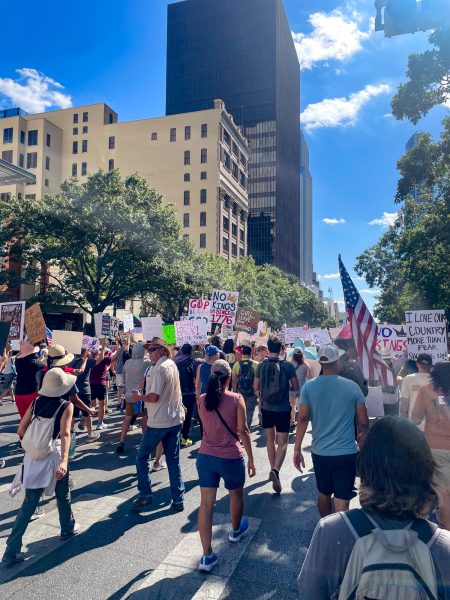
Although the protest remained nonviolent, student Juan Diego Guerrero claims he felt disappointed in regards to how short the march felt. After the march, protestors gathered around various tabling organizations. The sentiment was there but the direction the protest took was described as feeling aimless at points. Guerrero, a senior communication major, expressed his frustration towards the lack of solid demands that were given at the protest towards the government.
“We’re protesting authoritarianism, but what were our demands?” Guerrero asked. “What do we need to meet? What was the purpose other than just protesting for the sake of protesting?”
Texas politician and former gubernatorial candidate Beto O’Rourke gave a heartfelt speech about the fear and defeat citizens are feeling about the Trump administration’s policies. In the speech, O’Rourke reminded the audience about the importance of community and resilience.
“We are the people who defeated the most powerful empire on the planet to win our independence and ensure that no other American would ever bow to a king again,” O’Rourke said.
Junior Kinesiology major, Aisha Ajao claims how moved she was by O’Rourke’s speech.
“He didn’t say ‘we’re gonna fight and hopefully win.’,” Ajao said. He said we will win, so that just shows that one word changes everything.”
Responses suggest that other students experienced the protest as empowering, too.
“I’d say I felt a lot of power in that protest,” Guerrero said. “There was a lot, even if it wasn’t, it was just a one and done thing. You know, protest is like a constant effort.”

















Joaquin • Nov 10, 2025 at 1:13 pm
The “No Kings” march may have been loud, but it lacked depth, direction, and knowledge. Chanting about authoritarianism means little when the movement itself offers no concrete goals or policy solutions. It’s ironic to see people claim to defend democracy while rejecting its outcomes whenever elections don’t favor them. Real change doesn’t come from aimless marches or performative outrage. It comes from informed engagement, voting, and working within the system to create lasting impact. If students truly want to make a difference, they should join the St. Ed’s Civics Lab. That is true action. The Civics Lab will cause actual change in Austin and is led by people that actually care about your community and city. Meanwhile this No Kings performance is led by some DC folks that legitimately do not care about Austin or you.