
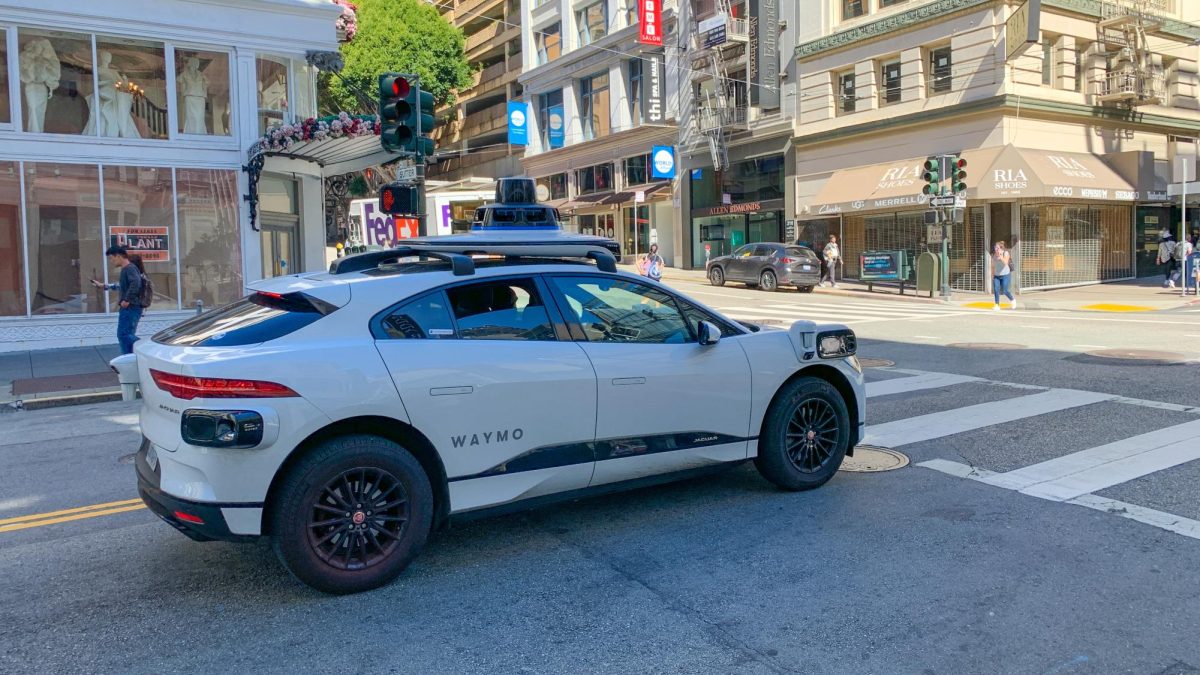
Like an incessant disease spreading across the face of the planet, no matter which streetlight or intersection you stop at, Austin has become infested with robotaxis of every kind. Waymo, of course, is the most famous — sporting its constantly swirling cameras and nearly endemic Austinite presence. Recently, however, there has been a noticeable increase in companies searching for robotaxi footholds in the city, especially in the wake of minor personal investments shaped by differing political opinions and technological optimism.
There is a growing resistance to human interaction within vehicles, a shift that stands in quiet opposition to America’s long-standing policy of prioritizing cars and highways as the dominant mode of transportation over public alternatives. This resistance exposes a gap in knowledge, ability and perceived necessity among individuals who seek transportation options that avoid communication, social negotiation or political friction altogether. Within that space emerges a strangely magical system: cars that drive themselves, ferrying people across town without conversation, gratuities or the moral theater of service work.
When you sit inside a Waymo, as innocuous as it may seem, you become immersed in a far different vibe than a regular Uber. It does feel futuristic to be driven by a machine, I will admit, and there is something tantalizing about being free of human interaction on your drive. This experience may initially induce a sense of accomplishment in independence, however, you must recognize the isolationism of such an experience. Human interaction can be limited in this age of remote work and technological advancement; little moments of connection and conversation are rare and restricted. The uninterrupted silence of a robotaxi is pulling us further apart, straining our wish for interconnectedness and proving to be flippant with its pathing.
Because these vehicles do not require tips or traditional labor, they are often framed as more economical, precisely because they are not of the same human-centered variety we have known for decades. Yet it is more important to recognize that entire sectors of society are now being quietly handed over to automation, whether or not we are prepared for the consequences. Tesla’s Robotaxi expansion illustrates this uncertainty clearly: despite being marketed as autonomous, these vehicles still require a human monitor in the front seat, a tacit admission that the systems are not ready for large-scale deployment.
In a real-world environment — messy, unpredictable and indifferent to idealized data — these systems can fail, and when they do, there is little recourse. Driving remains as one of the most deadly activities in the United States; crashes and wrecks carry consequences that ripple far beyond the moment of impact. Placing someone inside an automated vehicle removes a crucial dimension of human agency. While this surrender can feel liberating —- even comforting —- it risks stripping individuals of their capacity to respond, intervene or protect themselves when systems falter. In doing so, automation promises safety while quietly rehearsing a future where responsibility — and autonomy — are no longer ours to claim.
According to MSN, the robotaxi industry could push $105 billion by 2035, leaving little room for antagonism in a highly profitable engine. Who are we to dissuade against making more money? But when Waymo’s do things like: zoom past a stopped bus, obstruct traffic or even hit a child in San Diego, one cannot help but question their usefulness.
Perhaps they are a cheaper, more private, greener option, but are they truly the triumph of the future we were promised?




Danny A • Mar 28, 2026 at 7:55 am
So I agree and we have to understand that these advances should be used as tools and not as a replacements…inwhich big buisness know but turn away from(they are making money while the other crabs in the bucket suffer…regular folk)…Driverless vehicles makes alot of sense…Less law suits, is the biggest reason…Look at the AI adds …”have you been injured from a uber driver”…Also, most insurance companies do not insure uber drivers while driving …So yes its easy to uber but your doing it at your own risk which no one wants to do…The commericals and insurance comoanies do not unsure human drivers buy design…So you dont hear too many complaints from drivers that can easily do uber eats instead of diving people around(because this is set up by design so we need to complain to insurance companies, big businesses and make it harder to sue drivers)…If it was harder to sue drivers than there would be more human drivers…but right now Waymo is unfortunately winning…But keep being conscious of driverless vehicles and AI and hopefully the people paying attention will come up with better laws that do not stiffen progress but also protects human activity and working rights…
Tate Burchfield • Mar 23, 2026 at 3:16 pm
Why should this outmoding of service individuals truly alert us now? How is this different from the loss of “friction” that occured in the 20th Century (elevators, gas pumps, telephone operators)? Is it likely that in ten years time noone will care whether they take a Waymo or Uber? How does the interplay between labor and subjugation, interpersonal relationships and culture, and the environment point us to what should happen next? What is the recourse? What’s next? Who should apply the pressure??