

The transition from military service to higher education is often described as a single shift, but in my experience, it has been a series of transitions that continue to shape how I learn, lead and serve even 22 years later. Today, as an Army veteran, St. Edward’s University staff member and doctoral student, I find myself reflecting on how those layers come together in ways I could not have anticipated when I first left active duty.
I served in the early 2000s as a military police officer with the 1st Infantry Division, a structured, demanding and predominantly male environment. Enrolling at Texas Woman’s University in 2004 brought an immediate contrast that challenged my understanding of identity, belonging and voice. Over time, I found strength in that shift at Texas State University, while getting a master’s and working with KTSW 89.9 to host on-air radio conversations with local and campus veterans that showed me how digital media can create connections and serve as a bridge between military and civilian communities.
That period also included an unexpected form of storytelling when, at Texas State, I participated in an art project by Jenn Hassin, who is currently a professor of art at St. Edward’s University, transforming our military uniforms into papier-mâché works that mirrored the way many veterans reshape identity beyond service.
This perspective carried into my academic work, where my thesis examined women, sexual violence in the military and the need for stronger and accurate representation of female soldiers in literature, gaming and film — an early effort to advocate for visibility and agency through research and narrative.
Now, in my role as associate director of communications at the Holy Cross Institute, I approach communication as both strategy and responsibility. I focus on aligning messaging with mission, helping people understand not just what we do, but why it matters. At the same time, I am pursuing an Ed.D. in Leadership and Higher Education at St. Edward’s, which allows me to examine these ideas more deeply as a student.
Holding both roles at once has given me a unique perspective. As a staff member, I see how institutions operate behind the scenes. As a student, I experience those systems in real time. As a veteran, I carry a framework of discipline, adaptability and mission that continues to influence how I move through both spaces.
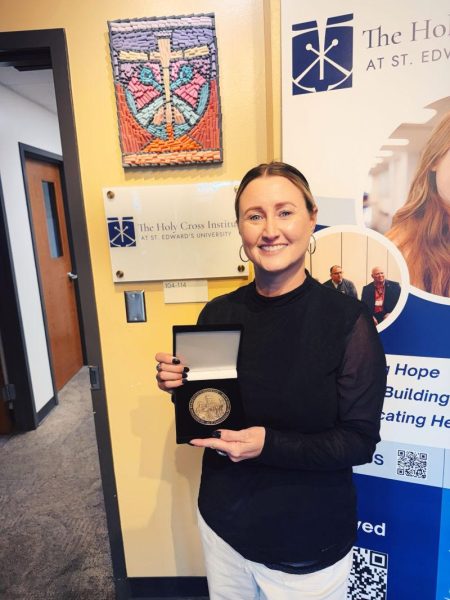
That sense of connection was clear to me on my first day in Premont Hall. When I walked into the Kathleen and Ralph Wilburn Room, in the suite where my office is located, I immediately noticed the details. Artwork by Hassin lined the walls, creating an unexpected, full circle moment of recognition from my time at Texas State. Nearby, stained glass windows, donated by the parents of a fallen Vietnam veteran, filtered light into the space. I felt something that is difficult to quantify but easy to recognize. I felt seen.
That feeling has continued through attending Hilltoppers Student Veterans Association (HSVA) events on campus. Connecting with HSVA President Miranda Lowensohn, HSVA Staff Advisor Kathleen Wilburn and other valued colleagues on our campus, especially around veterans issues, has brought a sense of continuity to my experience. Years ago, I was hosting conversations with veterans on the radio. Today, I am supporting student veterans through institutional work and academic research. The context has changed, but the purpose feels consistent.
At St. Edward’s University, support for veterans is both visible and woven into the broader mission of the institution. Student organizations, campus events and intentional programming create spaces where veterans can connect, lead and continue a sense of service. At the same time, there is an understanding that much of the veteran experience is not always visible. Some transitions are external, but many are internal, unfolding over time as individuals navigate new identities and environments.
From my perspective, veterans bring a distinct set of skills to higher education. We are trained to operate in complex systems, lead in uncertain situations and work as part of a team. These are the same competencies institutions aim to develop across all students, but for many veterans, they have already been tested in high-stakes environments.
As higher education evolves, there is an opportunity to better recognize veterans not just through support services, but as contributors to the academic community. My journey has been shaped by challenge, connection and growth, and at St. Edward’s, those experiences feel both grounded and forward-looking.

All comments must have a verified email in order to be approved. Please check your inbox after commenting.